When to Hire a Full-Time vs. Fractional CMO

How to choose the right marketing leadership model for your growing business
When I first started working as a fractional CMO in early 2023, most founders and CEOs that I spoke with knew that they were specifically looking for a fractional marketing leader. Over the past year, I hear from more leaders who are weighing whether to hire a full-time CMO or a fractional CMO.
If your company needs senior marketing leadership, the choice between a full-time CMO and a fractional CMO should start with one question: Do you already know what kind of marketing function you need?
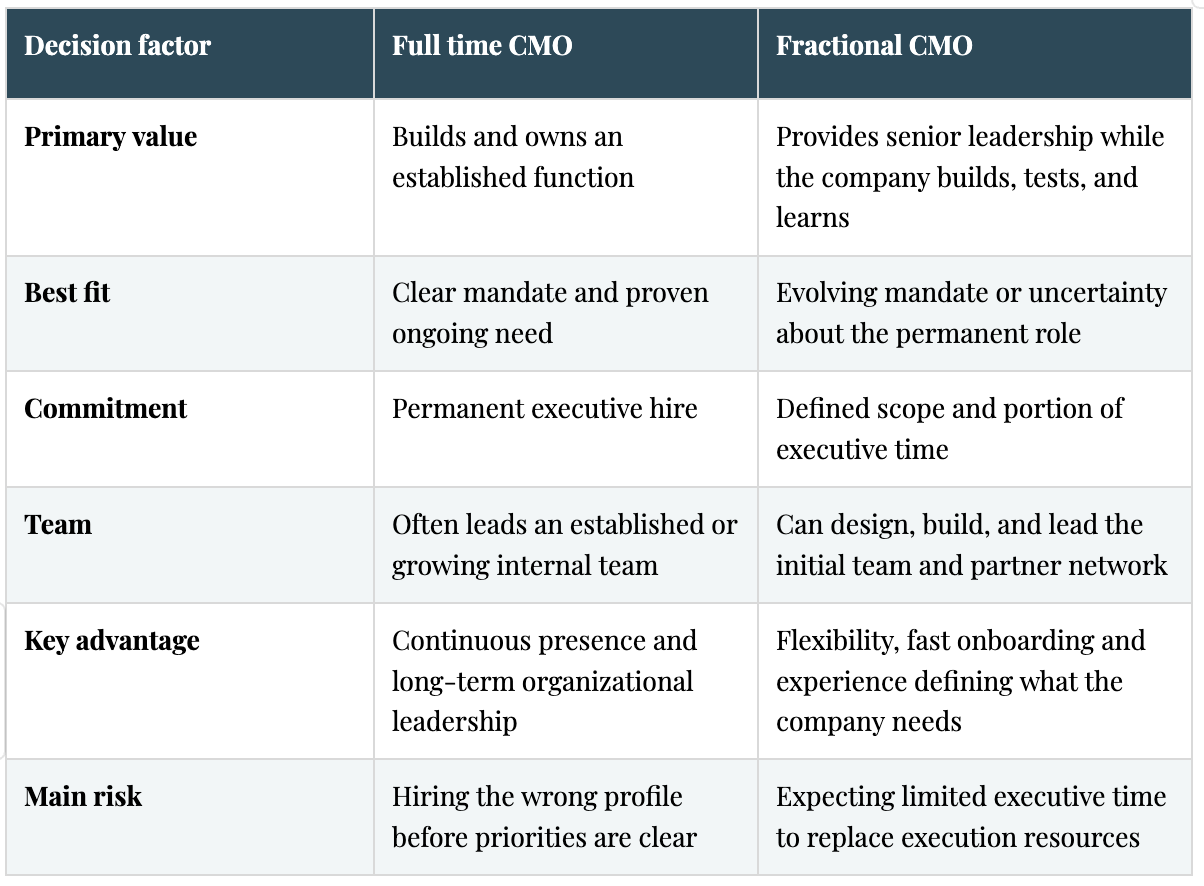
A full-time CMO is usually the better choice when your growth strategy, team structure, and leadership requirements are established enough to justify a permanent executive. A fractional CMO is often the better choice when you need to define those things first. The fractional model gives a company experienced leadership while it builds its strategy, tests what channels and distribution models growth will come from, and learns what its eventual full-time leader must be able to do.
Marketing is unusually multidisciplinary. The leader who can build a brand may not be the leader who can create a performance engine, establish product marketing, or lead an enterprise sales strategy. Hiring before the priorities are clear can lock the company into the wrong profile when flexibility matters most.
What is a fractional CMO?
A fractional CMO is an experienced marketing executive who leads the function for a defined portion of their time. They are not a part-time consultant. Fractional leaders operate as embedded executives. They’re directly accountable for results, participate in leadership meetings and decisions, set on-going priorities, build and lead teams, and manage resources.
The model differs from an advisor who makes recommendations but does not own the outcome, and from an agency that executes within one specialty. A fractional CMO connects business strategy to marketing strategy, determines which capabilities the company needs, and leads the people and partners responsible for delivery.
The core differences between full-time and fractional leadership
nnn
When a fractional CMO is the right choice
A fractional CMO is a strong fit when the company needs to build marketing, but is still testing into the function. The CEO may know growth cannot continue through referrals alone without knowing which audiences, messages, or channels can scale. Marketers or agencies may be active without a senior leader connecting their work to business goals. A new product or market may also require a different strategy or set of resources.
In each case, the immediate need is not “do more.” The company needs someone to answer foundational questions: Where can marketing create the most value? Which capabilities belong in-house? What should partners own? What data and operating processes are missing? Which work should happen first? What actually works for our business?
A fractional CMO can turn those answers into a strategy, resource plan, budget, measurement framework, and team design, then test the assumptions before the company commits to a permanent executive structure.
When a full-time CMO is the better choice
Full-time leadership makes sense when marketing has become a proven, ongoing executive function. The company understands its growth model, knows which marketing disciplines matter most, and has enough internal activity to require continuous leadership. The executive team also has a clear view of the experience, leadership style, and functional depth the role requires.
A full-time CMO is especially valuable when marketing decisions are frequent, intertwined with other functions, and difficult to manage within a limited weekly cadence. A permanent leader can devote more time to talent, organizational relationships, and long-range decisions.
The key is readiness. A busy team does not prove the company is ready for a full-time CMO. Hiring into an unclear strategy may produce months of reorganization before the company discovers it recruited for the wrong mandate.
When you actually need execution capacity
Sometimes the answer is that your business doesn’t need a CMO at all. If your company is early stage (pre-seed, seed or pre-revenue), your resources are better spent on a strong specialist or marketing manager who can quickly execute. If you don’t have a marketing background, you may want to hire a senior marketing advisor who can be a strategic sounding board and help you ensure that you’re building a solid foundation.
For small or midsize businesses with strong revenue, if the marketing strategy is clear and the gap is producing content, running campaigns, administering the CRM, or completing other hands-on work, the company may need specialists, an agency, or a strong marketing manager.
A true fractional CMO is not an executor. It’s unrealistic to expect one senior leader to be the strategist, department head, and entire execution team. Before opening any CMO search, separate leadership gaps from capacity gaps. Ask whether the business needs someone to decide what marketing should do, someone to do the work, or both. Then, fund the solution accordingly.
How fractional leadership can de-risk a full time hire
One of the most valuable outcomes of a fractional engagement can be a full-time hire that’s a better fit. I worked with a direct-to-consumer insurance agency that wanted to build its marketing growth engine and team, then hire a full-time CMO at the end of the engagement. The executive team knew it needed marketing leadership, but it wanted to validate the strategy and understand where growth would come from before committing to a permanent profile.
As we built the function, the company gained evidence about its priorities, channel opportunities, team gaps, and operating needs. I could then work with the executive team and recruiter to define the position and assess candidates' marketing and leadership skills.
The fractional period helps make the permanent hire successful. The company recruits against a tested mandate instead of a generic job description, and the incoming leader inherits a clearer strategy, stronger team, and functioning growth engine.
Questions to answer before choosing
A CEO considering a fractional CMO versus a full-time CMO should be able to answer the following questions:
What business outcomes must marketing influence over the next 12 to 24 months?
How confident are we about the audiences, positioning, channels, and capabilities that will drive those outcomes?
Do we need senior decision-making, additional execution capacity, or both?
Can we describe the permanent leader's mandate in specific terms?
Do we have the budget for the leader and the team, tools, and partners required to execute?
Would we benefit from learning and building before committing to a permanent structure?
If the mandate is clear and the organization needs sustained, daily executive leadership, begin the full-time search. If the company still needs to prove the strategy, build the function, and define the role, fractional leadership may be the more responsible first step.
A lower risk first step
If you are still unsure which path is right, start with a focused marketing assessment, strategy, and resource plan led by a fractional CMO or senior marketing strategist. That work should clarify the growth opportunities, capability gaps, budget, and leadership profile the business needs.
The assessment may point to a full-time CMO, a fractional leader who can build the foundation, a senior marketing advisor, or more execution capacity. The goal is to make the hiring decision with a clear view of the work marketing must do and what success means for your business.
Frequently asked questions
What is the difference between a fractional CMO and a full-time CMO?
A full-time CMO is a permanent, W2 executive dedicated to one company. A fractional CMO provides embedded, part-time executive marketing leadership with direct accountability for results. Both may set strategy, lead teams, manage budgets, and own results.
Can a fractional CMO help hire a full-time CMO?
Yes. A fractional CMO can clarify the role scope and description, work with recruiters, assess candidates, and prepare the strategy and team the permanent leader will inherit.
Should a start up, small or mid-size business hire a fractional or full-time CMO?
Stage and size alone don’t determine the answer. A startup with a proven growth model may need a full-time executive, while a larger company testing a new business line may benefit from fractional leadership. Consider mandate clarity, workload, readiness, and execution resources.
What should a company do before hiring either type of CMO?
Define the business outcomes marketing must support, assess current capabilities, separate leadership needs from execution needs, and build a realistic resource plan. If those answers are unclear, start with a focused assessment.
If you’re ready to explore whether a fractional CMO can help your business achieve your growth goals, let’s talk.